Exploring Photography as a Medium for Artistic Mediation
As part of a university diploma in art and therapeutic mediation, I spent six months working twice a week within a psychiatric department of a hospital in the Paris region.
The placement gave me the opportunity to observe and participate in several different care settings: a specialised residential facility (MAS), a psychiatric day hospital, inpatient psychiatry and a CATTP. Each environment brought together people with very different experiences, needs and relationships to illness or disability.
The MAS welcomed residents with complex and sometimes multiple disabilities, including physical, neurological, psychological or psychiatric conditions. Some had experienced strokes, while others lived with conditions such as Korsakoff syndrome or other neurological disorders. In inpatient psychiatry, I met people experiencing acute episodes or recovering from a crisis, including people living with schizophrenia, bipolar disorder, anxiety, depression or addiction. In the day hospital and CATTP, the participants were generally further along in their recovery, often working towards greater autonomy and social reintegration.
Working across these different settings made one thing particularly visible to me: there is no single experience of disability or mental illness. People can be at very different points in their journey, and disabilities can be highly visible, barely visible or not visible at all.
A photographic project across psychiatric services
The placement was built around a collaborative photographic project developed with the healthcare teams.
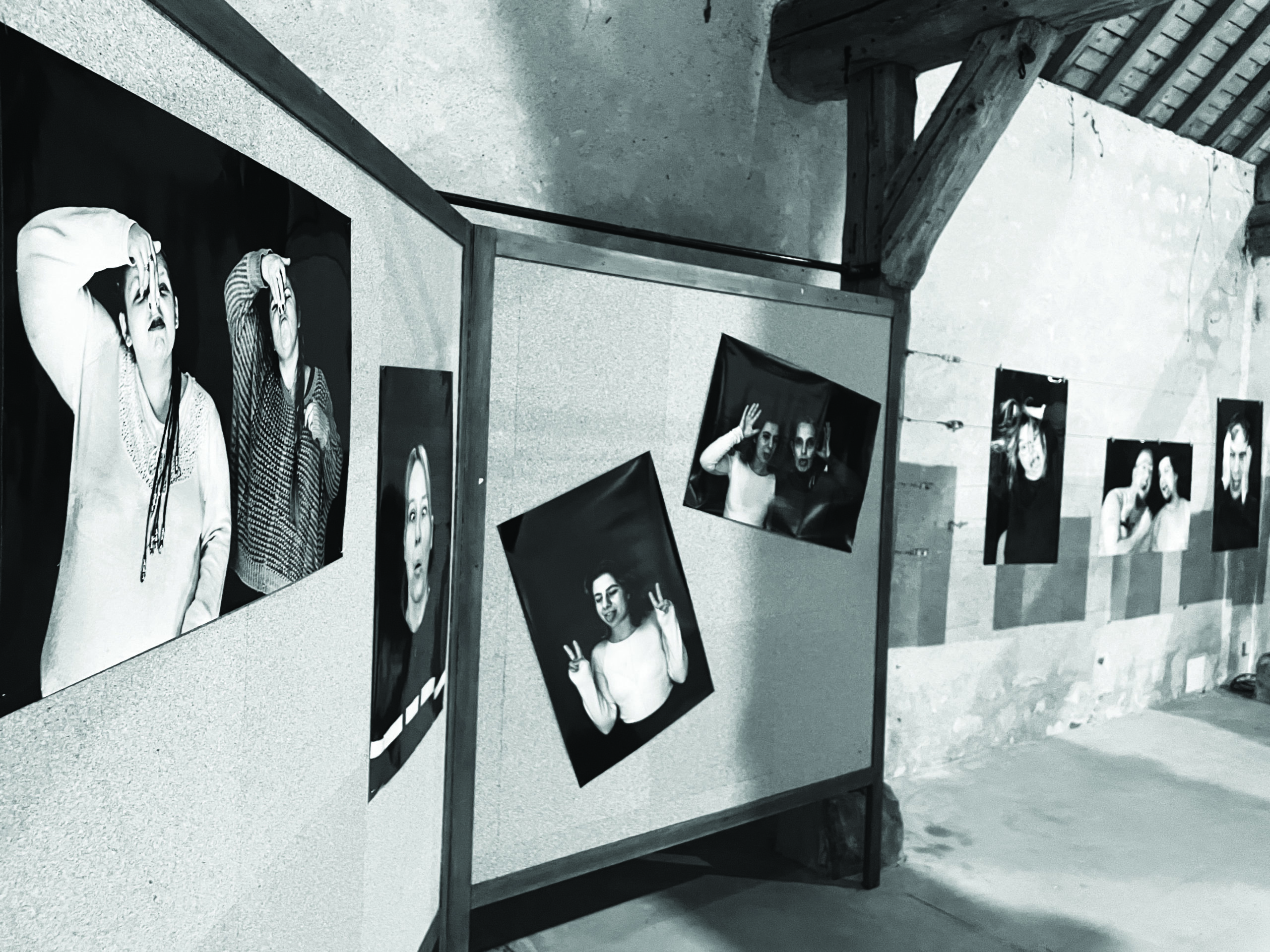
The project brought together patients and professionals from across the different psychiatric services in a series of portraits. We worked as a team of three photographer-art therapists, alongside psychiatrists, nurses, psychologists, occupational therapists, healthcare managers and other members of the medical and care teams.
The intention was not to create separate portraits of “patients” and “caregivers”, but to create images centred on people.
We therefore deliberately avoided identifying who was who in the photographs. Some images brought together patients and caregivers, others showed only patients or only professionals. Psychiatrists, nurses and other members of the healthcare teams participated alongside the people they cared for.
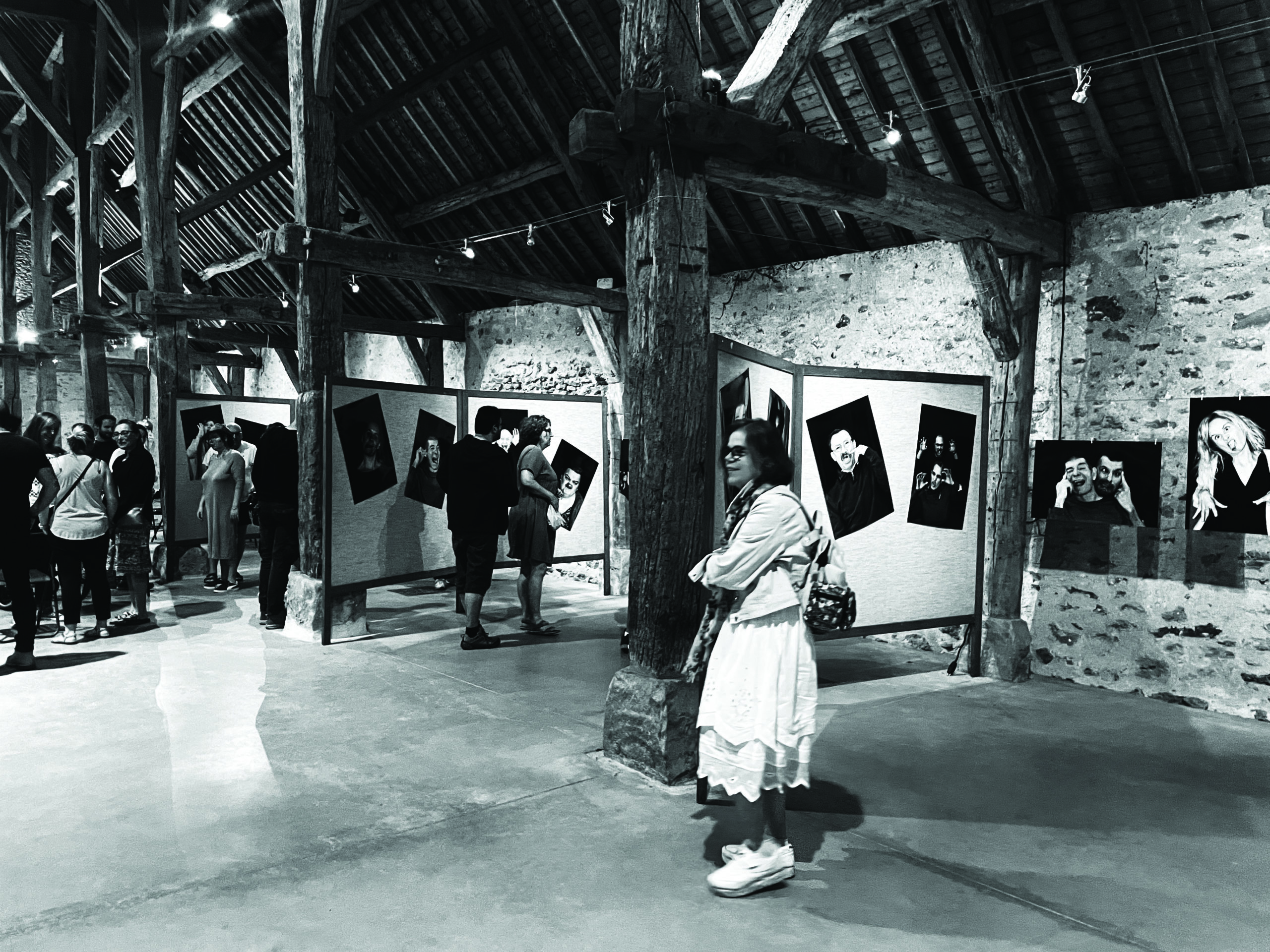
We also established a simple visual framework to create coherence across the final exhibition: black-and-white photography, generally featuring one to three people, with a shared visual language across the different photographers.
And then there was one important element: the grimace.
Making room for play
The choice of the grimace was not accidental.
A grimace is playful, spontaneous and slightly absurd. It can make us laugh. It can also temporarily disrupt the codes we usually associate with a hospital environment.
We wanted the photographic sessions to be moments where people could relax, experiment and have fun. The challenge was to create a situation in which everyone could feel comfortable enough to participate, while still producing images with a strong visual and artistic dimension.
This required much more than simply taking photographs.
Before each portrait, we spent time talking with the participants, understanding how they wanted to appear and what they felt comfortable doing. We discussed the way they wanted to be photographed and, afterwards, showed them the images before they were considered for the exhibition.
For some participants, these questions were particularly important.
Someone using a wheelchair might choose whether they wanted the wheelchair to appear in the photograph or whether they preferred to be photographed on another chair. One participant specifically wanted to be photographed standing. With the help of several people, we supported him in standing for the photograph — something that was important to him and that we discussed together beforehand.
These decisions might seem like small details, but they became meaningful parts of the process.
The photograph was not simply something being done to the participant. It became something constructed with them.
Beyond the photograph
This is where the therapeutic dimension of the project became particularly visible to me.
The photographic session created opportunities for conversations before, during and after the image was made. Questions about appearance, self-image, confidence, vulnerability and how we want to be seen naturally emerged from the process.
The presence of healthcare professionals was also essential. We were not working independently from the care environment, but as external creative practitioners within a broader multidisciplinary framework.
The artistic activity therefore became a different kind of space within the institution — one that was neither simply care nor simply leisure.
The camera created a reason to pause, talk, make choices and look at oneself differently.
For some participants, being photographed and potentially appearing in a public exhibition also raised questions about visibility and representation. What does it mean to be seen? How do I want others to see me? What part of myself do I want to show?
These questions were not necessarily expressed explicitly by everyone, but the process created room for them to emerge.
From workshop to exhibition
The photographs eventually became a public exhibition, presented in a significant cultural location within the city.
This transition was important.
The participants’ images were no longer confined to the hospital environment. They became part of a public artistic project, seen by people who did not necessarily know anything about the circumstances in which the photographs had been created.
The exhibition therefore created another shift in perspective: from patient to participant, from care setting to cultural setting, from individual experience to something shared with a wider audience.
The artistic decisions made by the photographers also became important at this stage. The initial therapeutic and relational process had to coexist with questions of composition, sequencing, visual coherence and exhibition design.
The project brought together these different layers rather than treating them as separate.
What I learned about designing a creative experience
This experience also changed the way I think about design.
Coming from a background in art direction, UX/UI and experience design, I naturally began to look at the workshops through another lens: what makes an artistic experience possible?
How do you create the conditions for someone to feel comfortable enough to participate?
How much structure is helpful, and when does structure become restrictive?
How can an activity be accessible to people with very different physical, cognitive and psychological abilities?
How do you leave enough space for individual choice while maintaining a coherent collective project?
And how can the artistic objective coexist with the needs of the people taking part?
These questions brought me back to something fundamental in my approach to design: an experience cannot be reduced to its final outcome.
The photograph is only the visible result. Behind it is an entire process of preparation, interaction, choice, trust, adaptation and collaboration.
A different way of thinking about art
One of the things that stayed with me most strongly throughout these six months was the realisation that artistic practices can occupy a much more significant place than we sometimes imagine within care environments.
From the outside, an artistic workshop can easily be perceived as an additional activity, something recreational or secondary.
But in this project, the creative process created opportunities for communication, self-expression, interaction and reflection. It introduced a different way of relating to oneself, to others and to the environment.
This does not mean that every artistic activity is inherently therapeutic, nor that art can replace medical or psychological care. Rather, it showed me the importance of the conditions in which an artistic activity takes place, and of the people who design, facilitate and accompany it.
For me, this became one of the starting points for a broader question that continues to guide my work today:
How can we design creative experiences that are not only engaging, but genuinely meaningful and accessible to the people who experience them?
This question sits at the intersection of my artistic practice, my work in UX and human-centred design, and my ongoing interest in ergonomics, cognition and creative processes.
It is also one of the reasons I continue to explore artistic mediation today.